

Envizura’s E3Trace
An Integrated Framework for Tracking Contaminants In The Environment and Reducing Exposure Risks
Executive Summary
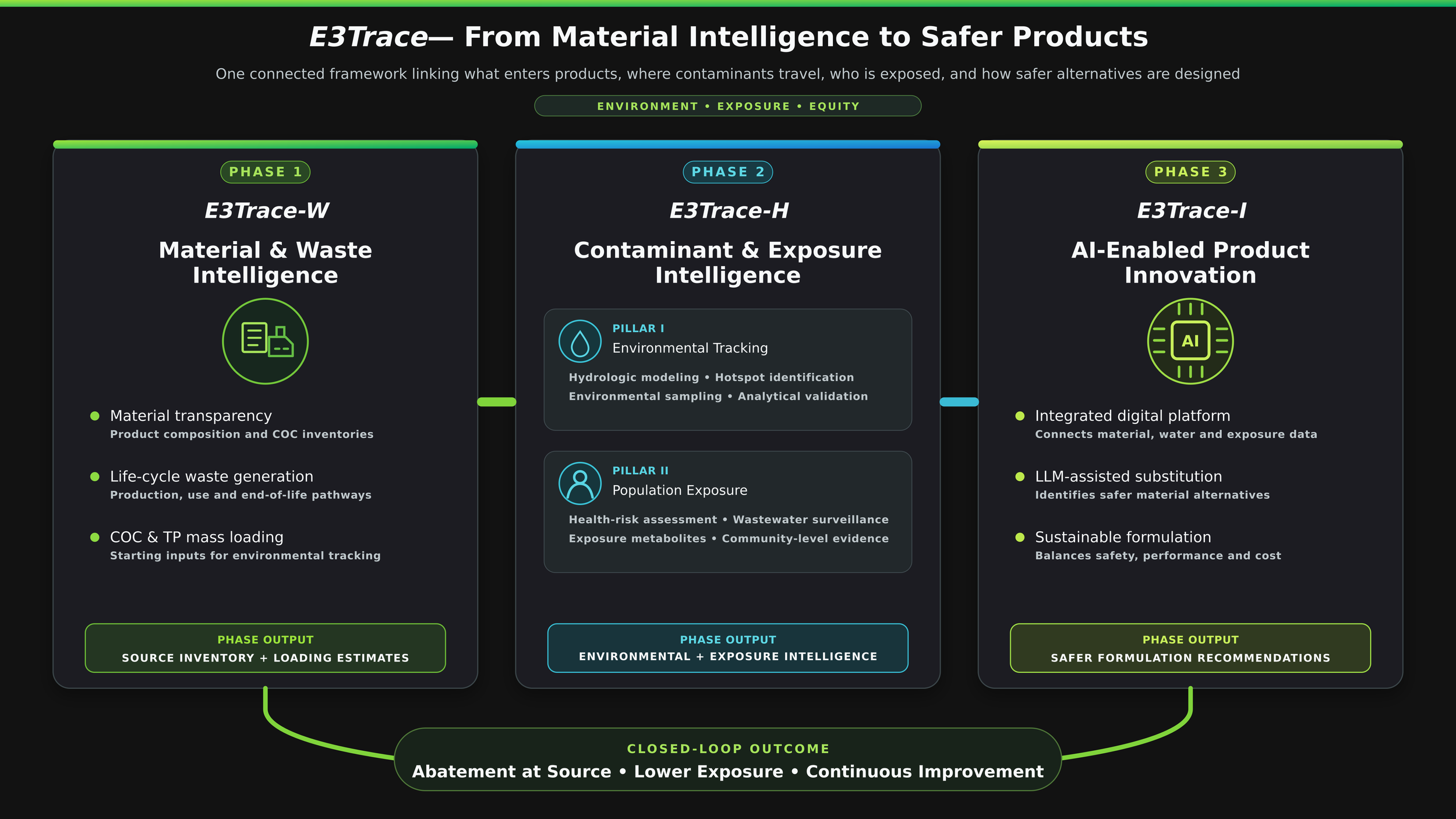
E3Trace is a three-phase decision-support framework designed to help manufacturers, utilities, regulators, and public-health partners identify chemicals of concern, track their movement through water systems, evaluate community exposure, and ultimately prevent pollution through safer product formulation. The framework connects material transparency, environmental monitoring, exposure intelligence, and AI-enabled product design within a single closed-loop system.
Phase 1 – E3Trace-W: Material and Waste Intelligence
Establishes where chemicals of concern originate and how much waste they generate throughout a product’s lifecycle. Material disclosures, manufacturer information, and established transparency platforms are used to evaluate production, distribution, recurring-use, and end-of-life waste across industries such as construction, pharmaceuticals, electronics, textiles, personal care, and agriculture. These estimates provide the initial contaminant-loading inputs for Phase 2.
Phase 2 – E3Trace-H: Contaminant Tracking and Population Exposure
Phase 2 converts material and waste data into actionable environmental and public-health intelligence through two integrated pillars:
Pillar I – Environmental Tracking: Uses hydrologic modeling, AI/ML-assisted hotspot identification, environmental sampling, and analytical testing to determine how chemicals of concern and their transformation products move through surface water and groundwater systems.
Pillar II – Population Exposure: Combines conventional health-risk assessment with wastewater-based epidemiology to evaluate community-level exposure. Wastewater measurements of contaminants, transformation products, and exposure metabolites provide evidence of actual population exposure and support more targeted public-health decisions.
Phase 3 – E3Trace-I: AI-Enabled Product Innovation
Integrates material, waste, environmental, and population-exposure data within a digital decision-support platform. A specialized large language model will use this combined intelligence to recommend safer material substitutions and more sustainable product formulations while considering performance, manufacturing feasibility, and cost.
Together, the three phases create a practical pathway from identifying hazardous materials to understanding their environmental and human consequences—and then preventing those impacts at the source. The former standalone indoor and personal exposure phase is no longer included; exposure assessment is now consolidated within Phase 2, Pillar II.
Meet the collaborators
A similar study
